
How do you set up a baby's bedroom?
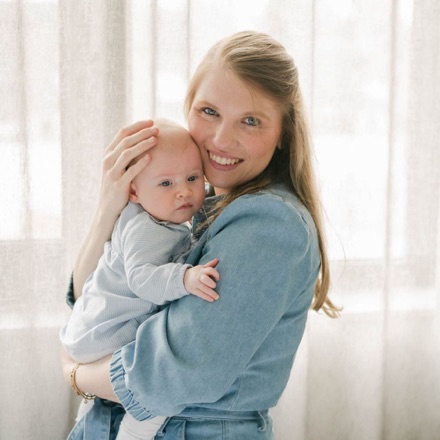 Kyra Hendrix, certified Gentle Sleep Coach® trained in the Kim West method · updated November 8, 2026
A nursery is safe and dark: an empty crib with a firm mattress and a tight fitted sheet, always sleeping on the back, 16 to 18 °C (61 to 64 °F) with 20 °C (68 °F) as the upper limit, and blackout. White noise masks sudden sounds. No pillows, soft toys, blankets, bumpers or baby nests in the crib.
The bedroom isn't just a safe place. It's also a signal: every time your baby goes there, the body knows sleep is coming.
So two things. First safety, then sleep quality.
According to Kyra, the temperature in the nursery should be between 16 and 18 °C (61 and 64 °F), with 20 °C (68 °F) as the absolute upper limit. Too warm is more dangerous than too cold, and a sleep sack with the right TOG keeps that temperature stable.
And then sound. White noise does a lot in the first months: it resembles what your baby heard in the womb, and it masks the sounds of the rest of the house.
An empty crib, and nothing else
Your baby sleeps safest in their own crib or cot. In it belongs:
- A firm mattress
- A tight fitted sheet, so it can't come loose
And nothing else. No pillows, no soft toys, no blankets, no bumpers, no baby nest. All those things raise the risk of SIDS.
A small comforter is possible, but only around five to six months, when your baby can move well on their own.
Always on the back
For every nap and every night. Sleeping on the tummy or the side is unsafe and raises the risk of SIDS. On the back, in an empty crib: that helps prevent SIDS.
Swaddling, and when to stop
Newborn babies have the startle reflex: the arms shoot up and waking follows. Swaddling gives a sense of security and holds that back.
Stop swaddling as soon as your baby shows signs of rolling. This isn't a guideline but a hard limit. Read why, and what to do after, in when to stop swaddling.
After that, you use a sleep sack. Less chance of suffocation than a blanket, and your baby can't cool down unnoticed. Do watch the TOG.
16 to 18 °C (61 to 64 °F)
Too warm is dangerous, and also the reason many babies wake up. Check it at the neck, not at the hands or feet. If the neck feels clammy, the clothing is too warm.
Dark, really dark
Light affects the production of melatonin, the sleep hormone. A dim room isn't the same as a dark room, and you notice the difference: with too much light, waking follows sooner.
Blackout isn't a luxury but one of the cheapest fixes there is.
White noise
A constant, soft background noise masks the sudden sounds in the house: a door, the neighbors, a car. It's exactly those sudden sounds that pull a baby out of light sleep.
Why this does more than comfort
A fixed sleep environment becomes a sleep association. The room smells the same, sounds the same, feels the same, and so becomes part of the signal that the night is starting.
That works together with your bedtime routine, and it helps against overstimulation: a calm, dark room is the place where too much stimulation fades again.
A dark room counts most in the last hour of the night, when sleep pressure is almost gone. See why your baby wakes at five.
Know someone going through this right now?
Send them this article with one tap.