
What is the Super Slow Shuffle?
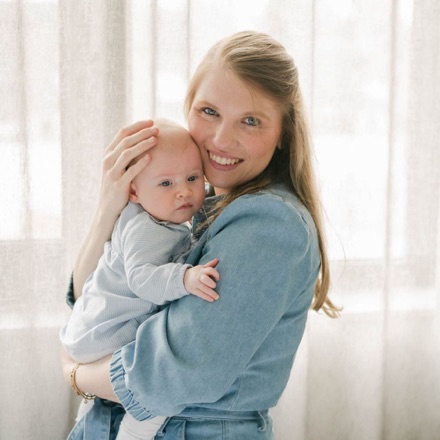 Kyra Hendrix, certified Gentle Sleep Coach® trained in the Kim West method · updated November 8, 2026
For babies from 4 months
The Super Slow Shuffle is gentle sleep training in four steps: start at bedtime, shift your familiar way of comforting a tiny bit every one or two nights, move that help to the crib, and then step back physically, bit by bit. The slower you go, the fewer tears.
Most sleep methods ask you to let go of something all at once. For a sensitive baby, or for a parent who can't bear crying, that's exactly the wrong ask.
The Super Slow Shuffle is a bridge between the gentle sleep shaping of the first months and real sleep coaching. You do change things, but so slowly that your baby barely notices where one step ends.
Who this works for
- Alert, sensitive babies who need a lot of closeness and find it hard to calm themselves.
- Parents who find it hard to hear their baby cry.
- Anyone who'd rather go step by step than all at once.
One thing up front, because people often talk around it: every change comes with crying. Whatever you choose, protest follows, because crying is the only language there is. What you do control is the pace. And you can always pause.
The principle: the sliding scale
You slowly do less physical work, so there's room for your baby to do more. Your support down, the skill up. Falling asleep alone is a skill, and it's only learned when there's something to learn.
The scale isn't a ladder you can only climb. If you can both handle less tonight, you slide back. That's not a setback but the system working as intended.
The four steps
1. Start at bedtime. Not at a nap, not in the middle of the night. At the end of the day sleep pressure is highest and falling asleep is easiest. Make sure there's been enough sleep during the day, and start with your familiar bedtime routine.
2. Shift your familiar way, a tiny bit. Do what you always do, rocking or shushing, but change something small about it every one or two nights. If you rock horizontally, do it a bit more upright. Stand a little further away. So small it barely shows.
3. Move to the crib. Now you move the help itself. You lean over the crib and rock, shush, pat or simply lay your hand on your baby, while your baby lies in their own bed. That holding can still be felt, but the crib is already there.
4. Step back physically. The same, but with less and less help and more and more pauses in between. Until that last bit happens on its own.
You can tell it's working by this: falling asleep goes faster.
Look at what's needed in the moment
Some babies want more contact, firm pressure from your hand, your closeness. Others need less stimulation, and too much shushing and stroking actually upsets them, so it takes longer. So vary the steps to what you see, not to what's supposed to happen.
And the night?
Start at bedtime, but don't leave the night to chance. Sleep close by at first, so you can respond quickly.
If your baby wakes outside feeding times, you choose one of two things: the same Super Slow Shuffle as at bedtime, or back to the familiar sleep help. Both are fine. What's not fine is switching, because then exactly what's in why sleep coaching gets stuck happens.
Trust the process, take your time, follow your own pace.
Know someone going through this right now?
Send them this article with one tap.