
When can a baby self-soothe?
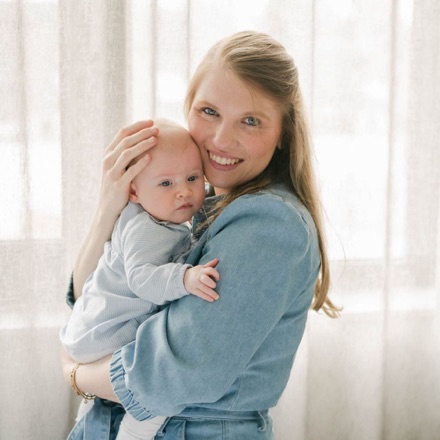 Kyra Hendrix, certified Gentle Sleep Coach® trained in the Kim West method · updated November 8, 2026
For babies from 2 to 4 months
A baby starts to self soothe around the third month, by bringing the hands to the mouth and sucking on them. That happens in three steps: hands to the chest, hands to the mouth, and then experimenting with fingers and wrist. It's the first step toward self-regulation, which helps your baby fall asleep on their own better and better.
Somewhere in the third month, something small happens that's big. Your baby discovers their hands, brings one to the mouth and starts sucking. For the first time without you.
The journey of the hands, in three steps
Step 1. The hands come to the chest more. The movements are still uncoordinated and uncontrolled. Your baby practices, and it gradually gets smoother.
Step 2. The hands reach the mouth and the sucking begins. This is the moment: that movement gets used to calm down.
Step 3. Your baby experiments with fingers and wrist, opening and closing.
It looks tiny, but for your baby this is a big victory. And it doesn't happen all at once: it builds up step by step, with lots of repetition, and you can literally see it happen if you pay attention. Those three steps also run through each other. One day the hand finds the mouth, the next day it goes past it again. That's part of it.
The golden tip: wait a moment
If the grumbling or a little crying starts, don't give the pacifier right away. Wait a few seconds and see whether your baby finds their own hands.
If that works, the pacifier is needed less, or soon not at all. How to take that step calmly later is in weaning off the pacifier. Every time your baby finds calm on their own is a repetition of the skill you'll be grateful for later. If you keep taking over those moments, there's no practice.
Why it happens
There are three reasons, and they run together:
- Because it feels good. Sucking calms, full stop.
- Because it's a bit too much. Too much noise, too many people. Then that hand is the way out. See also the overstimulated baby.
- Because your baby is practicing. A new skill gets repeated until it sticks.
The crying decreases
This month, the crying curve visibly drops for most babies. That's no coincidence: the brain develops, impressions get processed better, more can be done alone, and by now you read the signals better. Everything helps at the same time.
That's also the difference with purple crying, the peak that falls around two months. What comes after it should go down.
If the curve doesn't drop
And here is the most important part of this piece. If your baby keeps crying a lot, and you don't see that drop, see your doctor or pediatrician to rule out physical discomfort.
Think of silent reflux (especially with a lot of spitting up), of allergies, of which cow's milk allergy is the best known, or of skin complaints such as eczema. Those aren't things you solve with a sleep approach, and there's no need to muddle through them.
What this means for the night
A baby who can comfort themselves a little can also bridge the transition between two sleep cycles without you sooner. That's the foundation under learning to fall asleep on their own, and it's why things suddenly start going more easily around this age.
There's no hurry. Your baby is already practicing.
If what used to help suddenly doesn't work anymore, that's a sign of progress: old tricks stop working.
Know someone going through this right now?
Send them this article with one tap.